
Adult insomnia: causes, symptoms and what to do
Insomnia is more than a short night. It is a repeated difficulty falling asleep, staying asleep or sleeping until the desired time despite having a reasonable opportunity and circumstances for sleep. Daytime impact matters: fatigue, irritability, impaired attention, distress about sleep or reduced ability to function can all form part of the problem. An isolated bad night is common. Persistent insomnia calls for a structured response.

01Key points
- Insomnia combines a sleep difficulty despite an opportunity to sleep with distress or daytime impairment.
- A short episode after a stressful event is not the same as a disorder that has continued for months.
- Causes and perpetuating factors are often mixed: stress, timing, behaviour, substances, pain, menopause, breathing disorders, medicines and mental health can all be relevant.
- European and American clinical guidelines recommend CBT-I as the first treatment for chronic insomnia.
- Sleeping pills, melatonin and supplements should not become a long-term self-directed strategy.
What is adult insomnia?
Inserm describes insomnia as sleep that is insufficient in quantity or quality even though circumstances are favourable. It can involve difficulty falling asleep, prolonged awakenings during the night, waking earlier than intended or a persistent sense that sleep has not been restorative. The French national health service, Assurance Maladie, also emphasises daytime consequences.
This definition prevents two common misunderstandings. First, sleeping less than average without daytime difficulty is not automatically a disorder. Sleep needs and timing differ between people. Second, being short of sleep because there is not enough time allocated to it is not, by itself, insomnia. That is voluntary or externally imposed sleep restriction. The two can coexist, but they need different responses.
Short-term and chronic insomnia
Short-term insomnia often develops around an identifiable event: conflict, bereavement, a deadline, pain, travel, a job change or illness. It may improve as the trigger resolves. It still deserves attention, but its course and management differ from long-standing insomnia.
Detailed diagnostic criteria should be applied by a qualified professional. In its public guidance, Inserm summarises chronic insomnia as difficulty occurring more than three times a week for more than three months, with daytime impact. The 2023 European insomnia guideline likewise relies on a full clinical assessment, not one isolated sleep number.
These thresholds organise diagnosis. They do not mean that someone must wait three months to ask for help. Severe distress, a driving or occupational safety risk, or another concerning symptom warrants earlier advice.
The three common patterns
| Pattern | What the person notices | What else needs exploring |
|---|---|---|
| Sleep-onset difficulty | A long period awake after going to bed | True sleepiness time, worry, caffeine, circadian timing |
| Sleep-maintenance difficulty | Several awakenings or one prolonged awakening | Noise, pain, reflux, alcohol, menopause, apnoea, urination |
| Early-morning awakening | Waking before the desired time and not returning to sleep | Advanced timing, mood, time in bed, schedule and age |
These patterns can change. Someone may initially struggle to fall asleep and later start waking early. It is more useful to understand the current mechanism than to treat one label as permanent.
02What are the symptoms of insomnia?
The night-time complaint is the most visible part, but insomnia is not assessed from the night alone. A clinician also considers daytime function and the wider context.
Symptoms at night
Possible features include:
- difficulty falling asleep despite an adequate opportunity;
- frequent awakenings or a long period awake in the middle of the night;
- waking before the intended time;
- sleep that feels light, fragile or unrefreshing;
- growing anxiety as bedtime approaches;
- repeated checking of the clock or a wearable;
- feeling that sleep has become a performance to complete.
There is no perfect sleep-onset duration that every person must achieve every night. Repetition, distress and consequences are more informative. Our guide to how long it should take to fall asleep explains the difference between a useful reference and a rigid target.
Symptoms during the day
Insomnia may be accompanied by fatigue, impaired concentration, subjective memory problems, irritability, reduced motivation, headaches or worry. Some people feel exhausted but cannot nap. Others experience true sleepiness: a tendency to doze unintentionally.
The distinction matters. Daytime sleepiness is not the same as fatigue. Strong sleepiness, particularly while driving or carrying out hazardous work, requires an immediate safety response and investigation of the cause.
The insomnia paradox
The harder a person tries to control sleep, the more alert they may become. They move bedtime earlier, check the time, calculate the remaining hours, stay in bed to “at least rest” and cancel normal activities. These reactions make sense after a difficult night. Yet they can gradually link the bed with monitoring, frustration and mental arithmetic.
This cycle does not mean insomnia is imaginary. Sleep depends on biological, circadian, behavioural and psychological systems. Fear of poor sleep can simply become one of the factors maintaining a problem that began for another reason.
03What causes insomnia?
It is often more accurate to consider predisposing, triggering and perpetuating factors than to search for one cause. Two people exposed to the same stressful event will not necessarily develop the same sleep problem. The factor that starts insomnia may also differ from the factor that keeps it going.
Stress, anxiety and hyperarousal
A heavy mental load, uncertainty, conflict or trauma may keep the threat system active. The body can feel tired while the mind continues to anticipate. A second layer of worry may then appear: “If I do not sleep now, tomorrow will be impossible.” That prediction increases tension and makes sleep feel less spontaneous.
Anxiety and insomnia can influence each other in both directions. It is therefore too simplistic to assume that one always explains the other. An assessment looks at symptoms, timing, severity and functional impact.
Mood and mental health
Depression, anxiety disorders, post-traumatic stress and other mental-health difficulties can affect sleep. Persistent insomnia may in turn increase emotional vulnerability. Our article on the relationship between sleep and mental health covers this two-way association.
Waking early or having a bad night does not diagnose depression. Persistent low mood, loss of interest, hopelessness or suicidal thoughts, however, require prompt help. Contact the urgent medical or crisis service where you live if there is immediate danger.
Circadian timing and schedules
Sleep is regulated in part by the interaction between sleep pressure built during wakefulness and the circadian clock. Going to bed well before the body is ready can create a long period awake. Late bright light, highly irregular schedules, shift work and travel across time zones can move the biological sleep window.
A timing difficulty is not always insomnia in the strict sense. If someone sleeps well on their preferred schedule but cannot sleep at a socially required time, a circadian-rhythm disorder may be considered. Our guide to resetting the circadian rhythm explains the distinction.
Caffeine, nicotine, alcohol and other substances
Caffeine temporarily blocks adenosine signalling involved in sleep pressure. Sensitivity and clearance vary greatly. I cannot confirm a universal cut-off time that suits every adult. A structured personal trial, moving or removing the last caffeine dose for one to two weeks, is more informative than a rigid rule. See our guide to coffee and sleep.
Nicotine is stimulating. Alcohol can feel sedating at first, but it is not a treatment for insomnia; it may fragment the second half of the night and aggravate some breathing disorders. Cannabis and other substances can alter alertness and sleep architecture, with effects that depend on the product, dose, frequency and withdrawal.
Sleep environment and behaviour
Noise, excessive warmth, light, uncomfortable bedding, notifications or a partner’s movement can interfere. These factors are tangible, but they should not be treated as the sole explanation when a problem persists. A perfectly optimised bedroom does not cure chronic insomnia on its own.
Long periods awake in bed, late or lengthy naps, extreme schedule variation and continually moving bedtime earlier can also maintain the problem. A behavioural rule should not be punishment. Its purpose is to rebuild a clear association between bed, sleepiness and sleep.
Pain, physical symptoms and hormonal changes
Chronic pain, reflux, coughing, itching, hot flushes, nocturia and respiratory symptoms can interrupt sleep. Around menopause, hot flushes and night sweats can contribute to awakenings. Assurance Maladie also describes the frequent links with anxiety and unrefreshing sleep.
In these situations, addressing sleep alone is not enough. The symptom that wakes the person needs assessment and treatment, without assuming too quickly that the condition is “primary insomnia.”
Sleep apnoea and other sleep disorders
Loud snoring, witnessed pauses in breathing, choking awakenings, nocturia and daytime sleepiness can suggest obstructive sleep apnoea. Assurance Maladie describes the signs and diagnostic pathway. A sleep recording may be required. A consumer watch cannot confirm or rule out the diagnosis.
An irresistible need to move the legs in the evening may indicate restless legs syndrome. Repetitive nocturnal movements, unusual behaviours, narcolepsy or a neurological disorder require tailored assessment. Polysomnography is not routine for typical insomnia, but it may be appropriate when another sleep disorder is suspected.
Medicines
Some medicines affect alertness, timing, breathing, movement or trips to the toilet. Effects depend on the drug, dose and time taken. Never stop a prescribed medicine on your own. Prepare a complete list, including over-the-counter products and supplements, and discuss it with a doctor or pharmacist.
04Why can insomnia become chronic?
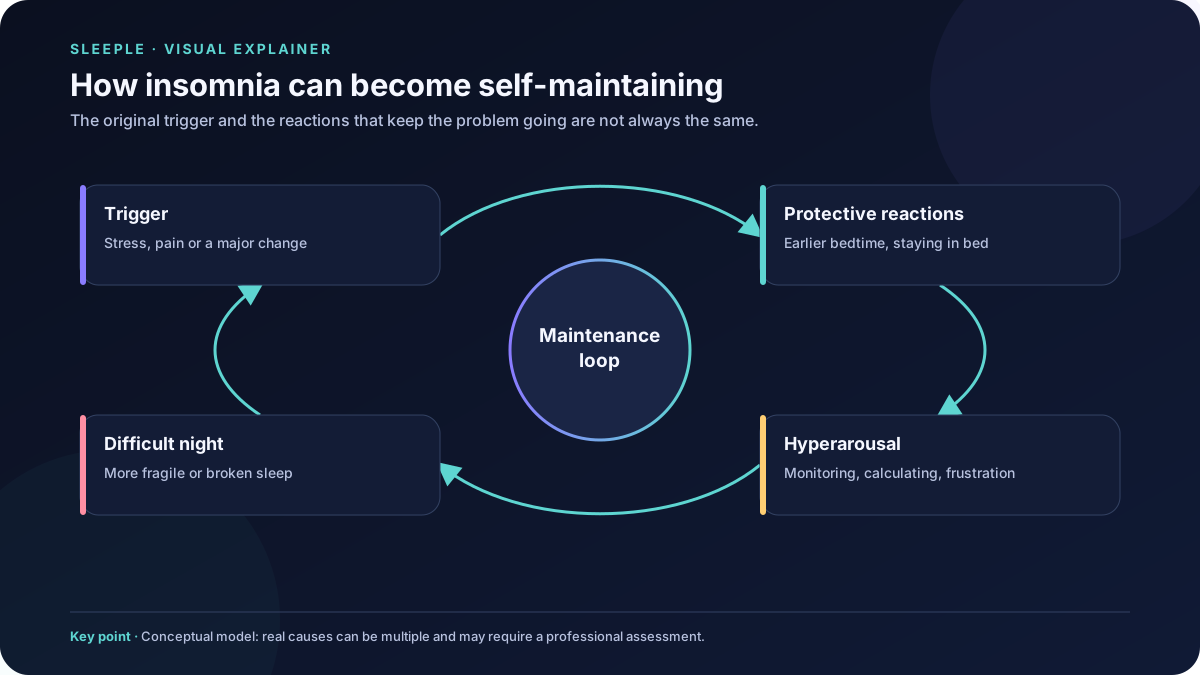
A useful clinical model separates three groups:
- Predisposing factors: sensitivity to stress, anxious traits, family history, demanding schedules or biological vulnerability.
- Precipitating factors: illness, separation, a new baby, pain, work, bereavement, schedule disruption or another event.
- Perpetuating factors: excessive time in bed, irregular wake times, compensatory naps, clock checking, worry, reducing normal activity and linking bed with wakefulness.
This model does not blame the sleeper. It shows how well-intentioned adjustments can continue disrupting sleep after the original trigger has faded. Perpetuating factors can be changed, particularly through CBT-I.
05Does your sleep problem need an assessment?
Ask six questions:
- Do I have a genuine and sufficient opportunity to sleep?
- Is the main problem falling asleep, remaining asleep, waking early or a combination?
- How many nights a week does it happen and for how long has it continued?
- What effect does it have during the day?
- Are there snoring, choking, restless legs, pain, very low mood or dangerous sleepiness?
- Which medicines, substances, schedules or life events changed before it started?
A sleep diary for about two weeks can help. Record bedtime, estimated sleep onset, awakenings, wake time, naps, caffeine, alcohol, relevant medicines and daytime functioning. The goal is not minute-perfect measurement. Perceived sleep is an estimate. The diary is intended to show patterns and provide context.
Do not let the diary or wearable become a continuous examination. If measuring sleep increases anxiety, simplify it or discuss that reaction with the clinician.
06What can you do for recent insomnia?
For a short episode without warning signs, a small number of consistent actions is often more helpful than a stack of “sleep hacks.”
1. Protect a consistent wake time
After a bad night, sleeping several hours later is tempting. A little flexibility may be realistic, but repeated large changes can shift circadian timing and reduce sleep pressure the following evening. Aim for a wake time that is reasonably consistent, compatible with your life and safe functioning.
2. Wait for genuine sleepiness
Fatigue is not always sleepiness. A person can feel drained, tense and highly awake. Heavy eyelids, yawning and difficulty following a page are more typical signs of a tendency to sleep. Going to bed only because “it is late” while the brain remains alert may prolong wakefulness.
3. Avoid a prolonged struggle in bed
If you are clearly awake and frustrated, get up for a calm activity in dim light: read a few pages, listen to quiet audio or practise relaxation. Return when sleepiness comes back. There is no need to time exactly twenty minutes; use sustained alertness and frustration as the cue.
This is part of stimulus control. It cannot command immediate sleep. It aims to weaken the association between bed and struggle. For a step-by-step version of this routine, see our guide on how to fall back asleep after waking up.
4. Reduce clock watching and calculation
Turn the clock away, move the phone out of reach and stop recalculating the remaining hours. Mental arithmetic feels like control but often turns sleep into a test. A more accurate statement is: “I cannot order sleep to happen, but I can make this period less stimulating.”
5. Test one variable at a time
Move caffeine earlier, remove evening alcohol, adjust noise or change a nap, but do not attempt fifteen interventions at once. If it is safe, keep one change for one to two weeks and observe. A simple experiment yields clearer information.
6. Continue the day, with safety first
Maintain ordinary activity and daylight exposure as far as practical after a poor night. This prevents life from becoming organised entirely around sleep. However, do not drive or operate machinery if you are struggling to stay awake. Safety takes priority over the schedule.
07What works for chronic insomnia?
The 2023 European guideline and the American Academy of Sleep Medicine clinical guideline place CBT-I first for chronic insomnia. It may be delivered individually, in a group or, where suitable, through a validated digital programme with an appropriate level of support.
What CBT-I includes
CBT-I is not another name for “use fewer screens.” It commonly combines:
- education about sleep regulation;
- stimulus control to strengthen the bed-sleep connection;
- a structured adjustment of time in bed;
- work on predictions, beliefs and behaviours related to sleep;
- relaxation when appropriate;
- relapse-prevention planning.
Time-in-bed adjustment, sometimes called sleep restriction, is not arbitrary deprivation. Diary data are used to bring time in bed closer to actual sleep and then adjust the window progressively. It can temporarily increase sleepiness and needs modification for driving, epilepsy, bipolar disorder, pregnancy, fall risk and other health issues. Professional guidance is preferable.
Why sleep hygiene may not be enough
Regular habits, a suitable bedroom and sensible management of stimulants can support sleep. The AASM guideline, however, recommends against sleep hygiene as a single-component therapy for chronic insomnia. Telling someone who has struggled for months simply to “drink less coffee and turn off screens” may be inadequate and can feel blaming.
Our guide to sleep-hygiene habits that genuinely help explains both their value and limitations.
08Medicines, melatonin and supplements
Medication decisions are individual and belong with a prescriber. Assurance Maladie notes that hypnotic medicines can cause adverse effects, reduced alertness and, depending on the product and pattern of use, dependence. They are generally considered for a defined situation and limited duration.
Melatonin is not a universal sleeping pill. Its usefulness depends on the problem, formulation, dose and particularly timing. It may be relevant to selected circadian conditions, while poorly timed use can be ineffective. Supplement quality varies and interactions are possible — for example, see our review of magnesium for sleep, forms and dose for what the clinical trials actually show.
“Natural” does not mean proven or risk-free. Evidence differs between products, and pregnancy, health conditions, driving and other medicines alter the safety calculation. Ask for advice rather than combining several agents.
09When should you seek help for insomnia?
Arrange an appointment if the problem persists, occurs several times a week, impairs functioning or leads to repeated reliance on substances or medicines for sleep. Advice is also appropriate when a physical, psychological, medication-related or circadian cause may be present.
Seek more urgent assessment for:
- uncontrollable sleepiness, dozing at the wheel or a near-miss accident;
- loud snoring, witnessed breathing pauses or choking awakenings;
- repeated pain, reflux, coughing or urinary symptoms;
- unusual movement, violent sleep behaviour or an irresistible need to move the legs;
- a sudden change after a new medicine or illness;
- manic symptoms, unusual agitation, suicidal thoughts or acute distress.
If sleepy while driving, stop somewhere safe. Opening a window, using loud music or relying on caffeine does not make an unsafe drive safe. Contact the emergency or crisis service where you live if there is immediate danger.
10How is insomnia diagnosed?
Diagnosis is mainly clinical. The clinician asks about the pattern, frequency, duration, daytime effect, work schedule, naps, substances, medicines, mental health and features of other sleep disorders. Assurance Maladie describes the interview and possible use of a sleep diary.
Polysomnography is not necessary for every case. It can become useful when the history suggests sleep apnoea, periodic limb movements, parasomnia, unexplained sleepiness or another condition requiring physiological recording. Wearable scores do not replace the clinical history or a validated sleep study.
The professional may also evaluate depression, anxiety, circadian disorders, pain, hormonal changes or medication effects. There is no single blood test that proves insomnia. Additional investigations are guided by symptoms.
11A practical fourteen-day observation plan
This plan is not a substitute for CBT-I. It can organise information before an appointment.
Days 1 to 3: observe without changing everything
Record approximate timing, naps, stimulants and daytime function. Check for warning signs. Do not pursue minute-by-minute accuracy.
Days 4 to 7: stabilise anchors
Choose a realistic wake time. Seek daylight in the earlier part of the day. Include physical activity appropriate to your health. Avoid going to bed far ahead of genuine sleepiness.
Days 8 to 11: reduce perpetuating factors
Hide the clock, leave the bed temporarily during sustained frustrated wakefulness, and reserve the bed for sleep and intimacy. Test one substance or environmental change.
Days 12 to 14: interpret the pattern
Review the frequency of difficult nights, estimated wakefulness, daytime impact and safety. If the difficulty is frequent, long-standing or disabling, take the notes to a doctor or CBT-I practitioner. Do not use two weeks of data to diagnose yourself.
12Common mistakes
| Mistake | Why it can maintain insomnia | More useful alternative |
|---|---|---|
| Moving bedtime much earlier after a poor night | Creates more awake time in bed | Protect wake time and wait for sleepiness |
| Repeatedly checking time and sleep score | Reinforces calculation and vigilance | Hide the clock and review trends less often |
| Staying in bed to force sleep | Links the bed with frustration | Use a calm activity outside bed if alert |
| Stacking supplements | Adds effects and interactions without treating the cause | Seek advice and target the mechanism |
| Expecting a perfect bedroom to cure insomnia | Chronic insomnia is multifactorial | Combine environment with evidence-based care |
| Sleeping very late after every difficult night | May shift the body clock | Keep wake time reasonably stable and safe |
Frequently asked questions about adult insomnia
Is this insomnia or just a temporary rough patch?
A rough patch often follows a recent event and remains limited in duration. Insomnia is more likely when the difficulty repeats despite an opportunity to sleep and creates distress or impairs the day. A diagnosis also considers frequency, duration, context and alternative causes.
How many hours does a person with insomnia sleep?
There is no single figure. Two people with insomnia may report very different durations. One mainly struggles with sleep onset, another with awakenings or unrefreshing sleep. Estimated total duration cannot define the disorder by itself.
Can chronic insomnia get better?
Many people achieve sustained improvement with appropriate care, especially CBT-I. Occasional bad nights remain part of normal life, but they can stop triggering a cycle of fear and compensation.
What is the best natural remedy for insomnia?
I cannot confirm a universally effective and safe natural product. The best-supported non-drug measures are not a supplement. They form a structured behavioural treatment involving regularity, stimulus control, time-in-bed adjustment and work on sleep-related worry.
Must every screen be banned at night?
No. The effect depends on light, duration, content and what screen use replaces. Lower brightness and less stimulating content may help, but a rigid ban is not a complete treatment. Working or scrolling in bed and repeatedly delaying bedtime are more specific behaviours to address.
Should I stay in bed to rest if I cannot sleep?
A short calm period is not a problem. If you remain alert, frustrated or calculating, a quiet activity outside bed may better protect the bed-sleep association. Return when sleepy; exact timing is unnecessary.
Can a watch diagnose insomnia?
No. A wearable may show a personal trend, but it does not measure sleep perfectly or understand the clinical context. Diagnosis depends on the interview, daytime impact, diary and targeted tests when indicated.
Why am I exhausted but unable to sleep?
Fatigue and sleepiness are different. Stress, hyperarousal, circadian timing, substances and learned worry in bed can maintain alertness despite exhaustion. Our guide to feeling tired but unable to sleep explores this pattern.
When is insomnia an emergency?
Insomnia alone is rarely a life-threatening emergency. Danger from sleepiness, acute confusion, manic agitation, serious breathing difficulty, severe pain or suicidal thoughts requires immediate help through local emergency services.
14Conclusion
Adult insomnia is better understood as a problem of sleep and daytime function than as a simple subtraction of hours. Observe the pattern, frequency, duration, consequences and associated symptoms. Simple anchors can help prevent a short episode from becoming a cycle of struggle. For chronic insomnia, assessment and tailored CBT-I are more reliable than a succession of products or internet tricks.
You cannot directly command the instant when sleep arrives. You can reduce alerting signals, stabilise useful cues and seek evidence-based care when the problem continues.
15Main sources
Evidence last checked: 17 August 2026.
- Inserm — Insomnia: mechanisms, chronicity and management
- Assurance Maladie — Adult insomnia: definition and contributing factors
- Assurance Maladie — Diagnosis and course of insomnia
- Assurance Maladie — Medical treatment of insomnia
- Assurance Maladie — How to sleep better as an adult
- Riemann D et al. — European guideline for the diagnosis and treatment of insomnia 2023
- Edinger JD et al. — AASM guideline for behavioural and psychological treatments
- NHS — Insomnia
General information: this content does not replace diagnosis, consultation or personalised treatment. Do not alter prescribed medicine without advice from a doctor or pharmacist.
How this guide was built
Sleeple separates scientific evidence, verifiable specifications and marketing claims. Limitations are stated, and affiliate compensation never determines our conclusions. See our method →