Polysomnography: understanding an overnight sleep study
An overnight recording can connect sleep stages with breathing, movement and heart rhythm. Here is what the test actually measures — and what it cannot conclude on its own.
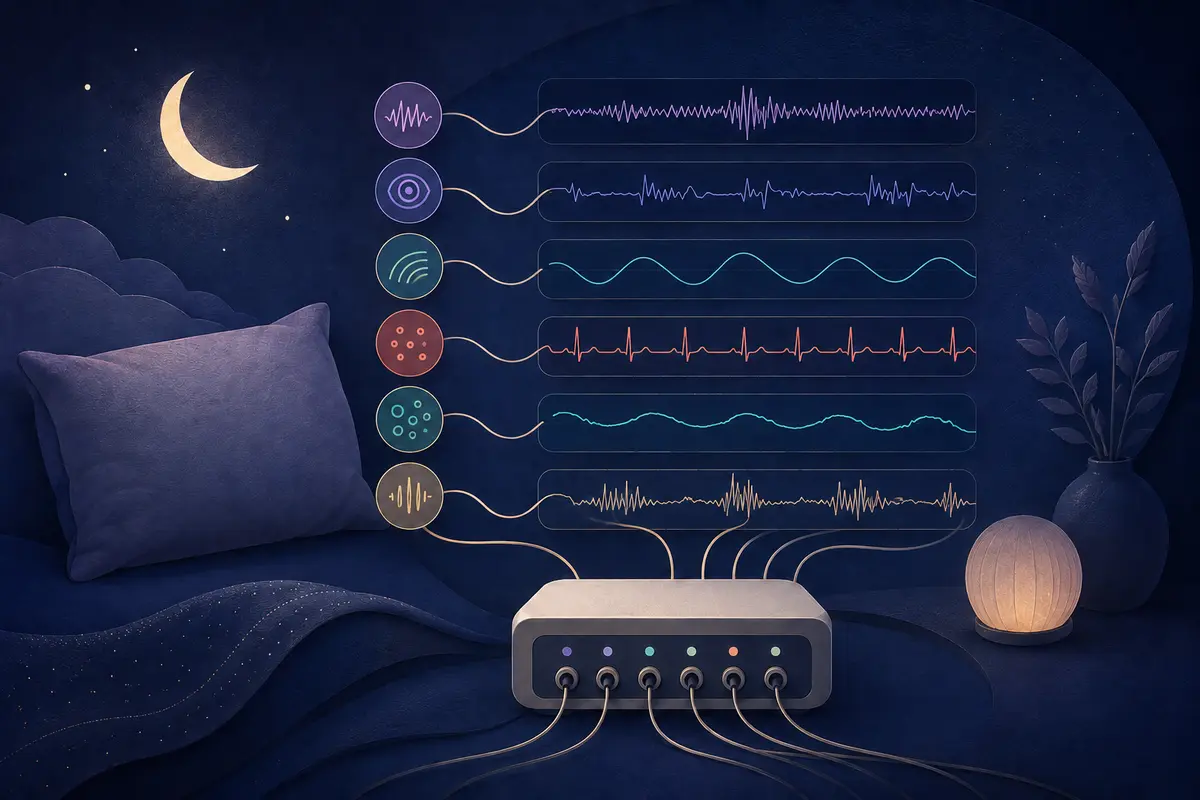
What is polysomnography?
Polysomnography is a sleep test that combines several physiological recordings during one night or, in selected protocols, over a longer period. The US National Heart, Lung, and Blood Institute describes sleep studies as painless tests that measure how a person sleeps and how the body responds to sleep problems.
Its main strength is synchronisation. The team can see whether a breathing event, movement, change in heart rhythm or unusual behaviour occurs during wakefulness, non-REM sleep or REM sleep. The equipment records natural activity; it does not send electricity into the body.
What do the sensors measure?
| Signal | Common sensor | What it adds |
|---|---|---|
| Brain activity | EEG electrodes on the scalp | Sleep onset, awakenings and sleep stages. |
| Eye movements | EOG electrodes near the eyes | Identification of REM sleep and support for sleep staging. |
| Muscle tone | Chin EMG and sometimes leg EMG | Changes in muscle tone, periodic movements and activity during REM sleep. |
| Breathing | Nasal cannula, airflow sensor and chest-abdominal belts | Airflow, breathing effort, apnoeas and hypopnoeas. |
| Oxygen | Finger pulse oximeter | Oxygen saturation and desaturations linked with events. |
| Heart | ECG | Heart rate and rhythm through the night. |
| Position, sound and video | Position sensor, microphone and camera when required | Snoring, body position and behaviour aligned with the other signals. |
The exact montage depends on the clinical question. Video-polysomnography is especially useful when unusual behaviours, parasomnias or movements need to be compared with physiological signals.
Polysomnography or a respiratory home sleep study?
A respiratory polygraphy or home respiratory study focuses mainly on airflow, breathing effort, oxygen, heart rate and sometimes position. It can often be carried out at home. Polysomnography adds EEG, EOG and EMG, allowing the team to determine whether the person is asleep and which stage they are in.
This distinction affects calculations. A respiratory study commonly relates events to recording time, whereas PSG can relate them to measured sleep time. The decision is therefore not simply to request “the most complete test”. It depends on the suspected disorder, other health conditions, any previous testing and the question the clinician needs to answer. Royal Papworth Hospital NHS sets out the practical differences between oximetry, respiratory polygraphy and inpatient polysomnography.
Why might the study be requested?
- To assess suspected sleep-disordered breathing when a complete recording is appropriate or a simpler test is insufficient.
- To document unusual behaviours, parasomnias or possible REM sleep behaviour disorder.
- To investigate periodic leg movements or night-time events that are difficult to classify.
- To support assessment of excessive daytime sleepiness; PSG may then be followed by a daytime multiple sleep latency test.
- To evaluate complex sleep problems alongside neurological, cardiorespiratory or neuromuscular conditions.
Insomnia does not automatically require PSG. Clinical history, examination, a sleep diary and sometimes actigraphy answer different questions. A sleep specialist selects the investigation most likely to change diagnosis or management.
How should you prepare?
- Follow the sleep centre’s instructions. They take priority over general advice, particularly for medicines.
- Do not change treatment yourself. Some medicines should continue; other protocols require a change decided by the prescriber.
- Arrive with clean, dry hair. Avoid gel, wax, oil or products that interfere with electrode attachment if instructed.
- Bring the requested items. Suitable nightwear, regular medicines, documents or breathing equipment according to the centre’s instructions.
- Report factors that changed the night. Illness, unusual sleep deprivation, alcohol, late caffeine or a missed medicine can affect the recording.
What happens overnight?
A physiologist or technologist attaches the electrodes and sensors, checks each signal and starts the recording around the planned bedtime. Leads are bundled to allow changes in position. The study may take place in a sleep centre or, for selected montages and indications, at home.
If a sensor comes loose or you need to get up, the team explains how to call for help. Sensors are removed in the morning. Adhesives may cause temporary discomfort, skin irritation or residue in the hair, but the test is non-invasive.
You do not need to produce a “perfect night”. The laboratory mainly needs enough technically valid recording to answer the clinical question.
What is included in the report?
| Measure | What it summarises | Caution |
|---|---|---|
| Total sleep time | Sleep measured during the recording. | One night may not represent usual sleep. |
| Sleep efficiency | Proportion of time in bed spent asleep. | The setting and purpose of the study can influence it. |
| Sleep architecture | Distribution and sequence of N1, N2, N3 and REM sleep. | Percentages vary with age, medicines and the night studied. |
| Apnoea–hypopnoea index | Average number of apnoeas and hypopnoeas per hour of sleep. | Symptoms, oxygen changes, position and scoring rules also matter. |
| Oxygen desaturation index | Oxygen drops meeting the stated criteria. | The drop threshold and signal quality need to be known. |
| Arousal index | Brief brain activations that may fragment sleep. | Arousals have several causes and are not a diagnosis on their own. |
| Periodic limb movement index | Leg movements that meet sequence criteria. | The finding does not automatically mean restless legs syndrome. |
The useful result is not one isolated number. It is the conclusion that integrates raw signals, technical quality, symptoms, medicines and the reason for the study.
What are the limitations?
- First-night effect: an unfamiliar room and sensors may change sleep.
- Night-to-night variation: breathing, position, alcohol, nasal congestion, medicines and sleep duration can change.
- A targeted test: PSG answers some questions, not every cause of fatigue or insomnia.
- Technical adequacy: failed sensors or too little sleep may limit the conclusion and occasionally require another recording.
A normal study does not dismiss persistent symptoms. It means that the protocol and recorded night did not demonstrate the suspected problem, or that another explanation should be explored. I cannot confirm the interpretation of an individual report without the full clinical context.
Frequently asked questions
Can you sleep normally with all the wires?
The night may feel different, but many people sleep enough for analysis. The report records sleep duration and any technical limitations.
Does polysomnography hurt?
No. Sensors record rather than stimulate. Attachment may still be uncomfortable or temporarily irritate sensitive skin.
Do you receive the results in the morning?
Not necessarily. Signals must be checked, scored and interpreted. Timing and the way results are delivered vary between centres.
Is one night always enough?
Often, but not always. Recording quality, night-to-night variation and the clinical question determine whether further testing is needed.
Can a smartwatch replace the study?
No. A watch mainly estimates sleep from movement and optical signals; it does not reproduce a full clinical montage.
Key points
- PSG combines EEG, eye movements, muscle tone, breathing, oxygen and heart rhythm.
- It is more comprehensive than a respiratory home study, but is not automatically the best first test.
- Instructions from the centre and prescriber take priority, especially for medicines.
- One index is not enough: the report requires clinical interpretation.
- A watch or app does not replace diagnostic polysomnography.