
Sleep inertia: understanding difficult waking in general
Sleep inertia is the temporary reduction in alertness and performance after waking. It can feel like brain fog, slow movement, poor decisions or an overwhelming desire to return to sleep. It is common, particularly after abrupt waking, insufficient sleep, a deep nap or waking at an unfavourable circadian time. It does not automatically mean that the preceding sleep was poor.
01Key points
- Sleep inertia is a physiological transition, not a lack of discipline.
- It can impair speed, attention and decision-making more than a person realises.
- Sleep loss, biological timing, the sleep depth before waking and repeated alarms can make it worse.
- No morning “hack” guarantees complete and immediate recovery.
- Before safety-critical work, recovery time and prevention of sleep loss matter more than a dramatic alarm.
What is sleep inertia?
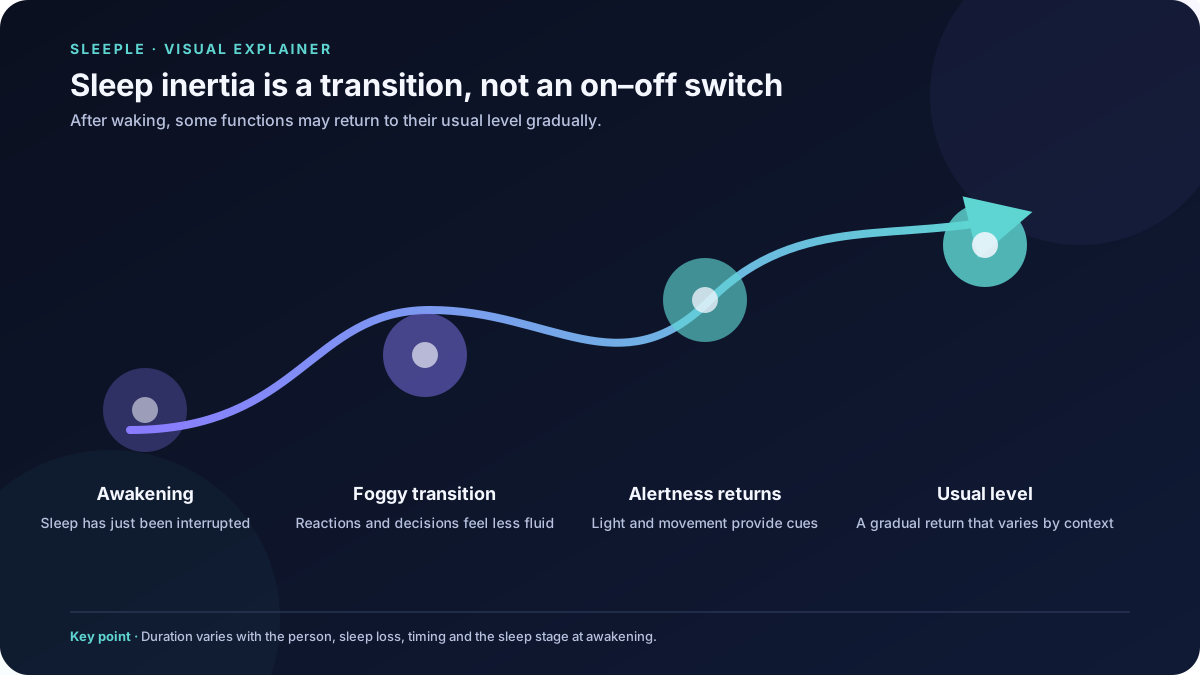
Sleep inertia describes the gap between being technically awake and having fully recovered some cognitive abilities. The eyes are open, but sustained attention, working memory, reaction time and judgement may remain temporarily impaired. A 2019 scientific review summarises the factors that modify this period and its real-world implications.
It occurs after night sleep and naps. It may feel like physical heaviness, irritability, mild disorientation, difficulty speaking, automatic behaviour or the need to hit snooze. Some people feel the state clearly; others underestimate the performance reduction.
Sleep inertia, fatigue and sleepiness are different
| Term | Practical definition | Typical timing |
|---|---|---|
| Sleep inertia | Transient impairment immediately after waking | Minutes and sometimes longer |
| Sleepiness | A tendency to fall asleep | Can occur at any time |
| Fatigue | Low energy or exhaustion without necessarily dozing | Variable and often longer lasting |
| Unrefreshing sleep | General sense that the night did not restore function | Judged across the morning and day |
Someone may experience strong inertia for forty minutes and then function normally. Another person may wake clearly yet remain fatigued all day. The response should differ. See daytime sleepiness versus fatigue for a fuller distinction.
02How long does sleep inertia last?
There is no identical duration for everyone. The NIOSH occupational-safety module gives a common range of around 30 to 60 minutes and notes that episodes can last longer. Experimental findings depend on the task tested, wake time, sleep debt, prior sleep stage and individual.
This variability explains two observations:
- feeling “awake enough” does not guarantee that every performance has returned to baseline;
- experiencing a brief episode one morning and a longer one the next does not necessarily indicate illness.
The pattern matters. Predictable slowness that resolves and creates no danger differs from intense confusion, prolonged automatic behaviour or daily incapacity affecting work.
Why do studies give different answers?
Studies do not use the same outcome. Some measure simple reaction time, while others use arithmetic, working memory, complex decisions or subjective feelings. Those abilities may recover at different rates. Protocols also wake participants after different sleep durations, stages and circadian times.
I cannot confirm that one precise boundary, such as exactly twenty minutes, reliably separates normal from abnormal. Duration, severity, risk and general function belong together.
03Why is waking up so difficult?
The brain does not switch states instantly
Sleep and wake are organised states. Networks involved in attention and decisions do not necessarily resume full function at the same moment. The classic review by Tassi and Muzet describes sleep inertia as a temporary dissociation between behavioural waking and performance recovery; see the reference review.
This helps explain why someone can turn off an alarm, answer briefly or walk to the bathroom without feeling fully aware of the choices.
Insufficient sleep
Sleep debt increases pressure to sleep and can worsen inertia. If an alarm interrupts sleep that the body strongly needs, the transition is more difficult. No morning routine can sustainably compensate for a chronically short night.
Our sleep-debt guide explains recovery without pretending that debt can be calculated to the minute. The aim is to identify repeated insufficiency and progressively restore a sleep opportunity compatible with function.
Circadian time
Waking during the biological night—for a shift, flight or very early alarm—can produce greater inertia. The circadian system still supports sleep and body temperature may be near its low point. The same nap can therefore have a different outcome at 2 p.m. and 4 a.m.
A social schedule that conflicts with the internal clock can create a chronically hard wake-up. If sleep and waking are easy on a late free schedule but morning obligations feel impossible, examine circadian timing.
Sleep stage at awakening
Inertia can be greater after waking from deeper sleep, including N3. However, cycles are not exactly ninety minutes for everyone and vary across the night. Counting fixed blocks cannot ensure that an alarm occurs in “light sleep.”
Consumer wearables estimate stages algorithmically and do not generally measure the EEG directly. A smart alarm may feel more pleasant, but I cannot confirm that it reliably eliminates inertia for every user.
Nap length and timing
A short nap may reduce the chance of entering deep sleep, without guaranteeing it. A longer nap can include more stages and produce marked inertia, especially when someone is sleep deprived. Need, time of day and the task that follows all matter.
Build a recovery margin before driving or a critical intervention. Do not assume that opening the eyes completes the transition. Shift workers should follow organisational policies and occupational-health guidance.
Repeated snoozing
Snoozing fragments the last portion of sleep and creates repeated transitions. It may feel like extra rest, but these short interrupted episodes do not replace continuous sleep. Repetition can also train a person to silence the alarm without rising.
That does not prove one occasional snooze is harmful. Needing it for an hour every morning mainly signals an issue with sleep duration, timing, health or organisation that deserves attention.
Medicines, alcohol and other substances
Hypnotics, some antihistamines, anxiolytics, antidepressants, pain medicines and other products may have residual effects. Alcohol can fragment sleep and impair the morning. Interactions and individual sensitivity matter.
Do not stop prescribed medicine yourself. Record timing, dose and onset of the problem, then speak to a doctor or pharmacist. “Over the counter” does not guarantee the absence of morning sedation.
04Does sleep inertia mean sleep quality was poor?
No. It can follow normal sleep, particularly after abrupt waking or waking from N3. Conversely, a person may jump out of bed after a short night because of stress and then experience impaired alertness later.
Do not use the first five minutes as a score for the whole night. Also assess:
- sleep duration and continuity;
- function after the transition;
- sleepiness throughout the day;
- breathing or movement symptoms;
- regularity of the problem;
- links with schedule and medicine.
If exhaustion persists long after the transition, see why you may feel tired after eight hours.
05How can you reduce sleep inertia?
1. Build in a safety buffer
The most reliable measure is organisational: do not place a critical decision in the first minute after waking. Prepare clothing and equipment, use a simple checklist and allow time before driving, complex medication tasks or machinery. In safety-critical occupations, handover and fatigue procedures are more important than individual tricks.
2. Get up rather than snoozing indefinitely
Place the alarm far enough away to require a safe movement. Sit, put your feet on the floor and rise. If you silence alarms without memory, use a simple reliable system rather than a sequence of puzzles that might be solved while partly asleep.
3. Use light
Light supports alertness and provides a timing cue. Open curtains or go outside when timing and safety permit. During dark seasons, increase ordinary indoor lighting progressively.
A therapeutic light box is more intense and is part of circadian treatment. Eye disease, photosensitising medicines and bipolar disorder require precautions. Our morning-light guide separates everyday daylight from therapeutic devices.
4. Move gently
Walking, stretching and beginning an active routine can support waking. Avoid abrupt exertion if you experience dizziness, falls or cardiovascular problems. Movement is not a replacement for sleep, but it adds cues consistent with daytime.
5. Drink and eat according to need
Water may feel welcome after the night, but dehydration does not explain every episode of inertia. Breakfast suits some people and not others. I cannot confirm one food that eliminates inertia. Use a routine that is tolerated and compatible with health needs.
6. Use caffeine thoughtfully
Caffeine can increase alertness, but its effect is not instant and late intake can impair subsequent sleep. It may temporarily mask insufficient sleep. Consider total dose, sensitivity, anxiety, pregnancy, health conditions and bedtime.
Do not base driving safety on coffee. If fighting sleep, do not start the journey or stop somewhere safe.
7. Protect sleep before the alarm
Adequate duration, coherent wake timing, daytime light and treatment of a disorder are the long-term levers. Compare general sleep-duration guidance by age with your function without turning a population range into a rigid personal quota.
06Popular countermeasures: what can we really say?
Cold showers
Cold can feel stimulating, but it does not guarantee full cognitive recovery. Very cold exposure may be unsuitable for some people and increase fall risk while disoriented. A comfortable shower and sufficient light are simpler choices.
Ninety-minute cycle alarms
Cycle length varies between people and across the night. Counting fixed blocks cannot reveal the exact stage at the planned time. A flexible alarm may improve experience but does not replace enough sleep.
Puzzle alarm apps
They may prevent easy dismissal. They do not treat sleep debt, apnoea or circadian misalignment. If the puzzle creates anger or stress each morning, the tool may not improve overall function.
“Energy” supplements
Claims of instantly eliminating inertia are rarely established for everyone. Ingredients, dose, interactions and quality vary. Do not combine multiple stimulants, and seek advice with medicines or health conditions.
07When can difficult waking indicate something else?
Chronic insufficient sleep
If you routinely sleep less than you need and require multiple alarms, restriction is the first issue to examine. Increasing sleep opportunity progressively is more coherent than making the alarm more aggressive.
Obstructive sleep apnoea
Loud snoring, observed pauses, choking, morning headaches, nocturia and daytime sleepiness can suggest apnoea. Assessment and possibly a sleep study are needed; a wearable score is insufficient.
Hypersomnolence and narcolepsy
Uncontrollable sleep episodes, severe sleepiness despite adequate opportunity or other characteristic symptoms require specialist assessment. A difficult wake-up alone does not establish narcolepsy.
Sleep drunkenness and confusional arousals
Marked confusion, prolonged automatic behaviour or inappropriate actions after waking may be described as a confusional arousal or sleep drunkenness. Terminology and diagnosis belong with a specialist. Record duration, behaviour, medicines, sleep loss and a partner’s observations.
Depression, bipolar disorder and other causes
Difficulty getting out of bed can accompany depression but does not prove it. A markedly reduced need for sleep with unusually high energy, racing thoughts or changed behaviour may need prompt assessment. Endocrine, neurological and medication-related causes are investigated according to context.
08When should you seek medical advice?
Ask for help if:
- inertia is severe, daily or prolonged;
- you miss work, education or essential care despite alarms;
- you drive or work before becoming fully alert;
- you fall asleep unintentionally during the day;
- you snore with pauses, choking or morning headaches;
- a partner observes confusion, unusual behaviour or violence;
- the problem began after a medicine or illness;
- it accompanies very low mood, suicidal thoughts or manic symptoms.
Sudden unusual confusion, a neurological deficit, chest pain or respiratory distress is not ordinary sleep inertia. Use emergency services.
09A practical seven-day plan
Days one and two: identify risk
Record estimated sleep time, alarms, duration of fog and tasks performed too soon. Identify driving or machinery within that window.
Days three and four: create a transition
Prepare the night before, remove unnecessary choices, use light and gentle movement, and add a buffer before critical work. Reduce repeated snoozing.
Days five to seven: address the cause
Move sleep opportunity earlier by a reasonable amount if it is insufficient, stabilise wake time and review substances and medicines carefully. If apnoea or hypersomnolence signs are present, arrange assessment instead of extending the experiment.
Evaluate several outcomes: safety, number of alarms, clarity after thirty and sixty minutes, later sleepiness and actual sleep duration. A better app score without functional improvement is not enough.
10Frequently asked questions
Why can I not wake up even after eight hours?
Eight hours in bed does not guarantee eight hours asleep or the right duration for every person. Circadian time, fragmentation, apnoea, medicine, previous debt and hypersomnolence may contribute. Persistent difficulty needs a broader assessment.
Did my alarm wake me from deep sleep?
It is possible for one episode, but it is not the only explanation. Sleep loss and biological time also matter. A watch cannot identify stage with polysomnography-level precision.
Should I use several alarms?
One backup may be reasonable. A long sequence fragments waking and can reinforce automatic dismissal. Address duration, timing and possible causes.
Does coffee eliminate sleep inertia?
It may improve alertness for some people, but takes time and does not guarantee complete performance. It cannot make drowsy driving safe and may affect subsequent sleep.
Must a nap be twenty minutes?
A short nap may reduce deep-sleep entry, but no duration avoids inertia for everyone. Timing, debt and individual biology matter. Leave a buffer before critical work.
Why is waking worse on some days?
Interrupted stage, sleep debt, timing, alcohol, medicine, illness and light can vary. Look for a multi-day trend rather than assigning one cause after one morning.
Is sleep inertia dangerous?
It becomes dangerous when critical performance is required immediately. Driving, healthcare, monitoring and industry need recovery time and appropriate procedures.
Can it be eliminated completely?
I cannot confirm a method that eliminates it for everyone. Aggravating factors can be reduced, waking can be organised better and disorders can be treated, but a brief transition remains physiological.
11Sleep inertia in safety-critical work
Sleep inertia deserves particular attention when waking is followed by urgent healthcare, driving, monitoring, air-traffic work, industrial intervention or a decision that affects other people. The issue is not only how a worker feels. Complex performance can remain impaired while the person believes they have recovered.
A safer organisation uses several barriers. Where possible, it avoids placing the most critical work immediately after sleep, provides a structured handover, uses checklists and permits a colleague to verify high-consequence decisions. Responsibility should not rest only on motivation or a cup of coffee.
A nap during an overnight shift may reduce some sleep pressure while introducing a period of inertia. The balance depends on timing, sleep duration and the following task. Workplace procedures, occupational-health advice and professional standards should guide practice. If someone remains unable to drive safely after rest, a theoretical waiting time does not make departure safe.
On-call awakenings
Before sleeping on call, prepare glasses, phone, documents, lighting and the response procedure. On waking, confirm the caller’s identity, repeat back the request and create a written trace. When a decision carries serious risk, a second check can reduce the effect of automatic behaviour.
These measures do not eliminate inertia. They make it less likely that temporary impairment will become a harmful error.
Emergency-service and healthcare contexts
Healthcare workers may wake to administer medicine, assess deterioration or make a triage decision. A standardised sequence—identify the patient, verify allergies, confirm dose and route, and document—remains essential even when the task appears familiar. Familiarity is not protection against an error made while partly awake.
Staffing and fatigue-management policies are organisational responsibilities. Individual workers should report patterns of severe sleepiness and near misses through appropriate channels instead of treating them as personal weakness.
12Why morning data can be misleading
A tracker may display a high “sleep quality” score after a difficult wake-up, or a low score before a good day. Algorithms combine estimated duration, movement, heart rate and sometimes other variables with proprietary weighting. The score is not a direct measure of cognitive readiness.
A smart alarm may select a window based on an estimated stage. If it wakes you earlier, inertia may feel lower while total sleep is reduced. Evaluate total duration, recovery after transition and later function rather than the first thirty seconds alone.
Use a simple one-week table:
| Indicator | Question |
|---|---|
| Estimated sleep duration | Was there enough opportunity to sleep? |
| Number of alarms | Do I rise or silence them automatically? |
| Clarity after 30 to 60 minutes | Does the transition resolve? |
| Later sleepiness | Am I fighting to remain awake? |
| Safety | Did I drive or work while foggy? |
This set is more informative than one composite score. If function worsens despite an adequate sleep opportunity, take the record to a clinician.
13What should you do after an exceptionally short night?
Recognise that the risk differs from an ordinary morning. Reorganise or postpone driving and the most hazardous work. A carefully placed short nap may restore some alertness, but the nap can itself cause inertia. Leave a recovery margin and do not treat the nap as permission to drive if sleepiness remains.
Use daylight and reasonable daytime activity, then return to an adequate sleep opportunity the next night. Avoid escalating stimulants into late afternoon or evening, which can perpetuate the cycle. Recovery from repeated restriction may require several nights; no single morning intervention instantly repays the whole debt.
Should you sleep in?
Some additional sleep may be appropriate after an unusual short night, particularly when no fixed obligation applies. A very large shift, however, can make the next sleep episode later. The decision should balance recovery, circadian consistency and safety rather than follow an absolute rule.
For chronic restriction, redesign the schedule instead of alternating between severe weekday loss and extreme weekend recovery. If work or caregiving makes that impossible, discuss practical support and health implications rather than relying indefinitely on alarms and caffeine.
14A partner’s role
A partner may observe behaviours the sleeper does not remember: repeated alarm dismissal, confused speech, breathing pauses, gasping or unusual movements. Record what was seen, approximate duration and whether the behaviour created danger. A short factual account is more useful than filming routinely without consent.
If someone is difficult to wake but breathing normally and this is their usual pattern, follow an agreed plan. If they cannot be roused as expected, have abnormal breathing, develop a new neurological sign or may have taken an overdose, seek emergency help. Do not assume severe unresponsiveness is ordinary inertia.
Partners should also avoid turning the morning into blame. A collaborative change to alarm placement, sleep opportunity or clinical assessment is more productive than describing a physiological transition as laziness.
15What should be recorded after a near miss?
Write a factual account as soon as safely possible: preceding sleep opportunity, nap, wake time, medicines, alcohol, number of alarms, task and the moment performance failed. Include whether head nodding, lane drift, confusion or memory gaps occurred. Do not rely on the impression that “nothing happened in the end.”
A near miss is a warning, not proof of one diagnosis. Share it with occupational health or a clinician when work, driving or repeated episodes are involved. The record can reveal whether the critical task routinely begins inside the inertia window.
16Does sleeping longer always make inertia worse?
No. Longer sleep may reduce deprivation even if one awakening from deep sleep feels harder. Judge the full day, not the first minutes. Deliberately shortening sleep to avoid N3 can create more severe sleepiness later.
If waking after adequate duration is consistently extreme, examine timing, fragmentation, medicines and hypersomnolence rather than reducing sleep. The goal is adequate sleep plus a safe transition.
17Conclusion
Sleep inertia explains why being awake does not mean being immediately operational. It is a brain-state transition influenced by sleep debt, circadian time, sleep stage, naps, substances and health. The first response is to protect safety and allow time.
Light, movement and a simple routine can support waking, but the principal lever sits upstream: sufficient sleep at compatible timing and assessment when inertia is excessive. A difficult wake-up is not a moral failure. It becomes a clinical or occupational problem when persistent, disabling or hazardous.
18Main sources
Evidence last checked: 17 August 2026.
- CDC/NIOSH — Sleep inertia
- Hilditch CJ, McHill AW — Sleep inertia: current insights
- Tassi P, Muzet A — Sleep inertia
- Sleep inertia: an updated review of mechanisms and countermeasures, 2024
- NHLBI — Sleep stages
- NHLBI — Sleep deprivation and deficiency
- Assurance Maladie — Daytime sleepiness
- Assurance Maladie — Sleep apnoea
General information: do not drive or perform hazardous tasks unless fully alert. Sudden confusion or neurological symptoms require urgent assessment.
How this guide was built
Sleeple separates scientific evidence, verifiable specifications and marketing claims. Limitations are stated, and affiliate compensation never determines our conclusions. See our method →