
Waking up too early: why does it happen and what can you do?
Waking before the alarm is not automatically abnormal. Sleep tends to be lighter in the final part of the night, while the circadian system gradually prepares the body to wake. It becomes a problem mainly when you regularly wake well before the desired time, cannot return to sleep and experience insufficient sleep, distress or impaired daytime function.
01Key points
- Early waking is defined in relation to the desired wake time and sleep need, not a universal clock time.
- Waking at 5 a.m. may suit one person and be severely disruptive for another.
- Later sleep usually contains more REM and less deep N3 sleep, making external and internal disturbances easier to notice.
- One morning awakening is not a diagnostic test for depression, cortisol, blood sugar or liver function.
- Frequency, duration, context, associated symptoms and daytime impact guide the response.
What counts as waking too early?
Early-morning awakening is one possible presentation of insomnia. The person wakes before the planned or required time and cannot resume sleep despite wanting to do so. Inserm and Assurance Maladie include early waking in their descriptions of insomnia when there is adequate opportunity and daytime impact.
There is no official hour before which waking becomes “too early.” Three questions create meaning:
- Intention: did you plan and want to sleep longer?
- Total sleep: does waking remove sleep that you need?
- Function: are you well or impaired the next day?
Someone who falls asleep at 9:30 p.m. and wakes naturally at 5:30 may have obtained enough sleep. Someone who fell asleep at midnight and wakes at 4:30 may be accumulating sleep loss. The same clock cannot tell the whole story.
Early waking or a night awakening?
| Situation | Useful description |
|---|---|
| Night awakening | Waking in the middle of the sleep period, followed or not by more sleep |
| Early-morning awakening | Final awakening significantly before the desired time, without returning to sleep |
| Natural early rising | Early but satisfying wake time, adequate sleep and good function |
| Sleep cut short by a demand | Waking because of work, an infant, noise or another obligation rather than spontaneously |
The boundaries are practical rather than absolute. For middle-of-the-night episodes, read why you keep waking at night. If the concern focuses on one time, our guide to waking around 3 a.m. explains why a clock reading has no fixed medical meaning.
02Why is the end of the night easier to disrupt?
A normal night cycles through several stages. Deep N3 sleep is generally concentrated earlier, while REM sleep occupies a larger proportion later. The NHLBI describes this organisation and the usual succession of stages.
At the same time, the circadian wake signal evolves as morning approaches. Body temperature and many physiological signals follow daily rhythms; daylight then strengthens timing information. Noise, pain, a hot flush or a worrying thought may therefore be more noticeable late in the sleep period.
This does not make REM “bad sleep,” nor does it mean that recovery is finished after the first hours. Sleep stages have complementary roles. Routinely losing the final part reduces total sleep and may reduce REM-rich sleep, so the first half of a night cannot always be treated as sufficient.
03Common causes of waking too early
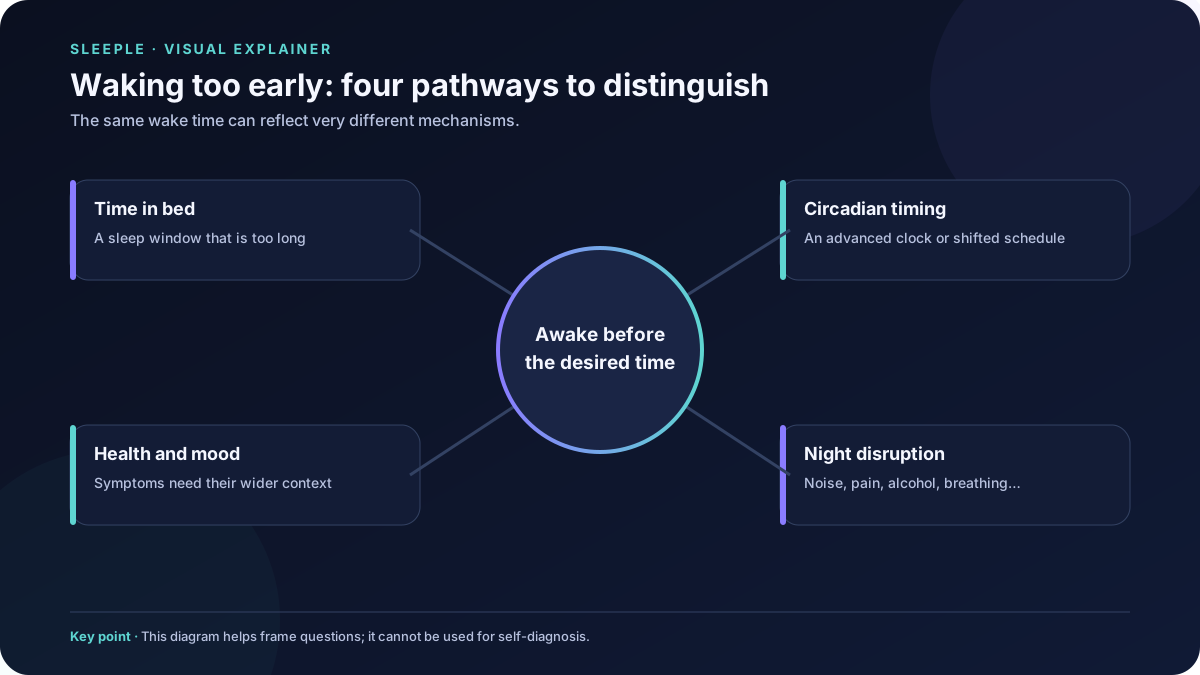
Bedtime is earlier than your sleep need supports
After several poor nights, people often move bedtime earlier to recover. If potential time in bed becomes longer than the amount the body can sleep, sleep may end sooner. Moving bedtime earlier again creates even more wakefulness and can perpetuate the pattern.
Review the timeline. When did genuine sleepiness begin? How much time is allocated to bed? If bedtime moved one or two hours earlier after the first episodes, the compensation itself may now contribute.
An advanced circadian clock
In advanced sleep-wake phase disorder, sleepiness and waking occur earlier than desired. A person becomes very sleepy in the early evening, sleeps early and wakes very early, yet may sleep well when permitted to follow that schedule. The NHLBI describes the major circadian disorders.
One early awakening cannot establish this diagnosis. There needs to be a persistent shift of the overall rhythm and conflict with required timing. Light timing matters: poorly timed treatment could advance the clock further instead of delaying it.
Stress, anticipation and hypervigilance
Near morning, the mind may instantly retrieve the task list. The prediction “I will wake at five again” creates monitoring around that time. Looking at the clock confirms the script, and calculating what remains raises arousal.
Stress should not become a default explanation. Physical symptoms, timing and environment also require attention. When mental alertness is clearly involved, changing the relationship between bed, time and worry is more useful than assigning a hidden meaning to the hour.
Mood and depression
Early waking can occur within depression, but it is neither proof nor a screening test by itself. Depression is assessed from a broader pattern: persistent low mood, loss of interest, slowing or agitation, guilt, appetite change, concentration, energy, thoughts of death and functional impact.
Seek prompt help if waking accompanies sustained low mood, loss of pleasure, hopelessness or suicidal thoughts. Use the emergency or crisis service where you live if there is immediate danger. Our guide to sleep and mental health explains the two-way relationship.
Light, noise and temperature
Dawn through the curtains, heating, rubbish collection, traffic, a neighbour, a pet or a partner can occur on a schedule. Check external cues before assuming an internal disease. A safe sleep mask, suitable curtains, appropriate ear protection or changing a heating timer can provide a simple test.
Do not create a safety risk. Maintain the ability to hear a smoke alarm, infant or necessary signal. In summer, earlier sunrise and a warming room can together explain a seasonal pattern.
Alcohol, caffeine, nicotine and meals
Alcohol may increase initial drowsiness while fragmenting later sleep. Caffeine and nicotine can affect continuity in sensitive people. A heavy meal and reflux can contribute. Blood-glucose problems are possible in specific medical contexts, but waking at one hour does not diagnose hypoglycaemia or metabolic disease.
Do not start a supplement marketed for “night-time blood sugar” based on a wake time. If you have diabetes, sweating, tremor, confusion or glucose-lowering treatment, ask the healthcare team for personalised instructions.
Menopause and hot flushes
Hot flushes and night sweats may cause or accompany waking. Assurance Maladie describes sleep problems around menopause and their association with anxiety.
Record whether heat seems to precede the awakening or is noticed after it. That cannot prove causation, but it helps the assessment. Management may combine bedroom conditions with clinical discussion of menopausal symptoms.
Pain, reflux, cough and urination
Pain that increases toward morning, reflux, coughing or a full bladder can wake a person. One toilet trip is different from several new episodes. Late fluid intake can contribute in some cases, but excessive fluid restriction is not a universal solution.
A persistent symptom needs assessment in its own right. Treating “insomnia” while ignoring pain or a urinary problem is unlikely to work.
Obstructive sleep apnoea
Obstructive sleep apnoea can produce brief arousals that are not all remembered. Loud snoring, witnessed breathing pauses, choking, morning headache, nocturia and daytime sleepiness support assessment. Assurance Maladie lists common features.
An app or watch cannot exclude apnoea. Respiratory polygraphy or polysomnography may be selected according to the clinical picture.
Medicines and substances
A new medicine or a change in dose or timing can affect sleep, breathing, pain, mood or urination. Prepare a complete list including non-prescription products. Do not change treatment on your own; ask a doctor or pharmacist whether the temporal link is plausible.
04What the wake-up time cannot diagnose
Online explanations assign fixed meanings to 3, 4 or 5 a.m.: a cortisol “spike,” liver detoxification, nutrient deficiency, trauma or a spiritual signal. Hormonal and metabolic rhythms are real, but they vary with habitual sleep timing, light, age, shift work, medicines and health.
A repeated hour can coincide with a sleep-cycle transition, scheduled noise or learned anticipation. It is not a biological test. Endocrine disease, hypoglycaemia and other conditions require compatible symptoms and validated investigation when indicated.
05What should you do during an early awakening?
Stop checking the time repeatedly
If the time is not needed for an immediate decision, keep the screen and clock out of view. The first glance can trigger: “Only two hours remain.” Calculation creates urgency that the body treats as a cue to wake.
Release the goal of sleep
Bring attention to contact points, comfortable breathing or a neutral sound. Do not measure whether the exercise is “working.” Rest is possible without making every minute another attempt.
Leave bed if a struggle develops
If you are clearly alert, irritated or planning the day, get up for a quiet activity in dim light. Return when sleepiness reappears. The guide to falling back asleep after an awakening explains this stimulus-control principle.
You do not need to wait exactly twenty minutes. Avoid timing yourself. Use sustained alertness and frustration as the cue.
If planned wake time is near
When the alarm is approaching, fighting in bed for a long period may be less useful than beginning gently. Do not let that decision become an automatic rule that moves wake time earlier each week. Record the gap and examine the pattern across days.
06What should you do the next day?
Keep the planned wake time as far as possible, seek daylight and maintain normal activity. A large sleep-in or long late nap can reduce subsequent sleep pressure. If sleepiness is dangerous, safety comes first: do not drive and adapt the day.
Do not automatically move bedtime several hours earlier. Wait for clear sleepiness within a coherent range. Reduce late caffeine and alcohol used as a sleep aid. Regular physical activity appropriate to health supports sleep overall but is not an instant treatment for early waking.
07How can light be used without shifting the clock the wrong way?
Light is the strongest synchroniser of the circadian system. Its effect depends heavily on biological timing. Morning exposure generally advances the clock. For someone who is already too early, adding intense light very early may be inconsistent with the goal. Evening light tends to delay timing, but may also interfere with sleep onset and is not a universal prescription.
Begin by observing the pattern and using ordinary outdoor daylight across the day. If a marked advanced phase is suspected, ask for advice before using a therapeutic light box. Eye disease, photosensitising medicines and bipolar disorder require precautions. Our guide to morning light and sleep explains timing without prescribing an individual dose.
08A fourteen-day diary
Record:
- bedtime and estimated sleep onset;
- the first sustained early awakening and actual rising time;
- whether genuine sleepiness was present at bedtime;
- morning and evening light;
- naps, caffeine, alcohol and exercise;
- noise, temperature, pain, hot flushes, urination, reflux or snoring;
- fatigue, mood and sleepiness the next day.
Include free-day timing. If you sleep well on an earlier schedule and feel restored, the conflict may mainly concern timing. If sleep remains short or fragmented on every schedule, other factors need more attention.
After two weeks, test one plausible variable. Correct a recurring noise, return to a sleepiness-guided bedtime, or move alcohol and caffeine. One controlled change can be interpreted; ten simultaneous changes cannot.
09When should you seek advice?
See a healthcare professional when early waking:
- occurs several times a week and persists;
- shortens sleep and impairs concentration, mood, work or safety;
- comes with loud snoring, breathing pauses or choking;
- is associated with uncontrollable sleepiness;
- accompanies pain, cough, drenching sweats, reflux or repeated urination;
- begins after a new medicine or dose change;
- occurs with sustained low mood, loss of interest, unusual agitation or suicidal thoughts.
For chronic insomnia, the 2023 European guideline and American Academy of Sleep Medicine guideline recommend CBT-I first. Sleep-hygiene advice alone is often insufficient.
10Common mistakes
| Mistake | How it can worsen the problem | Alternative |
|---|---|---|
| Moving bedtime even earlier | Extends time in bed | Wait for sleepiness within a stable range |
| Looking at the time after each movement | Reinforces anticipation and calculation | Hide the clock |
| Treating the hour as a diagnosis | One hour has no unique cause | Track symptoms and context |
| Taking alcohol or random supplements | Adverse effects and untreated cause | Seek appropriate advice |
| Using very early bright light without a plan | May advance timing further | Assess the circadian pattern |
| Sleeping very late each weekend | Alternates between incompatible schedules | Seek realistic consistency |
Frequently asked questions
Why do I always wake one hour before my alarm?
The circadian system can anticipate a regular schedule, while light, noise, stress or the natural end of sleep may coincide. If you feel restored, it may not be a problem. If sleep is insufficient or the pattern is distressing, assess the full schedule.
Does waking at 4 a.m. mean cortisol is too high?
No. Cortisol follows a daily rhythm, but a 4 a.m. awakening is not a hormone test and does not prove dysregulation. Endocrine investigation is driven by the wider clinical picture.
Is early waking always a sign of depression?
No. It may occur with depression, but also with advanced timing, stress, light, alcohol, pain and other factors. Depression is diagnosed from a group of symptoms and a clinical assessment.
Should I take melatonin?
Not automatically. Melatonin is a timing signal, so administration time matters. If the body clock is already advanced, poorly chosen timing may be unhelpful. Ask for advice before repeated use.
Must I stay in bed until the alarm?
If you are calm, remaining for a while is reasonable. If calculation, alertness and frustration develop, a quiet activity outside bed is more consistent with stimulus control. Return if sleepiness comes back.
Why is early waking worse in summer?
Earlier sunrise, warmth, open windows and morning noise can contribute. Social timing may also change. Test the environment without assuming it is the only cause.
Can I move my wake time later naturally?
Sometimes, particularly when bedtime has become too early or the whole schedule is advanced. Regularity, sleepiness-guided bedtime and light timing matter. A marked circadian shift needs an individual plan to avoid using light at the wrong time.
Can a watch identify the cause?
No. It may estimate timing but cannot determine whether waking comes from apnoea, pain, noise, a mood disorder or an advanced clock. Treat it as a trend, not a diagnosis.
12Four patterns that illustrate why context matters
These examples are not diagnostic templates. They show why the same wake time can call for very different responses.
Pattern one: the sleep opportunity has moved earlier
Someone usually went to bed at 11:30 p.m. After a difficult week, they begin getting into bed at 9:30 without genuine sleepiness, fall asleep around 10:30 and wake at five. They interpret five as a failure, move bedtime earlier again and spend more of the night awake.
The first logical test is to stop expanding time in bed and wait for clearer sleepiness. That does not prove that early bedtime is the only cause, but the timeline makes it plausible. If sleep and daytime function improve when the window becomes coherent again, the observation is useful.
Pattern two: the whole circadian schedule is early
Another person struggles to remain awake after 8 p.m., falls asleep easily at nine and wakes at 4:30 even during holidays. Sleep is reasonably good on that schedule, but social and work commitments require something later. The difficulty may concern circadian phase rather than sleep maintenance alone.
A diary that includes light, meals, activity and free days helps document the pattern. Any phase-shifting strategy needs correct timing. Copying a strong morning-light routine designed for someone with delayed timing could be counterproductive.
Pattern three: a symptom causes the awakening
Someone wakes at four with burning reflux, cough, pain, a hot flush or a full bladder. They try several meditations but the symptom repeats. The priority is not perfecting relaxation; reflux, pain, menopause, breathing or the urinary cause needs assessment.
Record the likely sequence, meals, medicines and other features. Do not use the timeline to make a diagnosis on your own. Bring it to an appointment so that the symptom and sleep complaint can be considered together.
Pattern four: waking has become anticipated
After several awakenings caused by noise, a person begins to fear 4:45. They open their eyes, check the time immediately and analyse the coming day. Even after the noise is removed, the anticipation continues. Stimulus control, reducing clock exposure and CBT-I can target the perpetuating factor without denying the original trigger.
13How to prepare for a useful appointment
Describe observations before presenting a hormone theory. State when the pattern began, how many nights it occurs, bedtime, desired wake time, actual wake time, estimated total sleep and daytime function. Include work schedules, free days, recent travel and light exposure.
Bring a list of all medicines and supplements and note associated features: snoring, choking, sweating, pain, reflux, urination, restless legs, low mood and sleepiness. If a partner observes your sleep, a report of breathing pauses or unusual behaviour is more useful than an app interpretation.
A clinician may extend the diary, investigate a cause, adjust a medicine, refer for CBT-I or request a sleep study when the picture justifies it. Polysomnography is not compulsory for every early awakening. The decision depends on symptoms, not whether the awakening occurs at a memorable round number.
14How can you tell whether a strategy is actually helping?
Do not judge a change from one night. Keep it stable long enough to observe a trend unless adverse effects occur. Define several outcomes: final wake time, estimated total sleep, time spent struggling, how you feel after rising, daytime sleepiness and ability to function.
A strategy can be beneficial even if the clock changes little—for example, when there is less calculation, distress and next-day disruption. Conversely, gaining twenty tracker minutes while becoming more anxious is not an unambiguous improvement. The outcome should be interpreted at the level of the person, not the display.
What if the pattern returns after improving?
A recurrence does not prove that progress has been lost. Travel, illness, seasonal light, stress and schedule changes can temporarily reintroduce early waking. Return to the basic observations: did bedtime move, did a symptom appear, did morning light change, or did time in bed expand?
Use the response that matches the current mechanism rather than escalating every intervention. If the pattern now includes a new symptom or greater daytime impairment, seek reassessment instead of assuming it is the same episode.
Should you compensate with an earlier evening every time?
Not automatically. Moving bedtime earlier after each early awakening can enlarge time in bed and make another early final wake more likely. Protect an adequate opportunity, but let genuine sleepiness guide entry into bed. If total sleep is clearly inadequate, increase opportunity gradually rather than in a single large jump.
The following day may still require reduced demands. That is different from redesigning the whole schedule around one night. Keep safety first, avoid drowsy driving and return to the planned observations.
Can breakfast timing fix early waking?
A coherent first meal helps define the day, but breakfast alone does not diagnose or treat the cause. Do not delay eating in a medically inappropriate way in an attempt to force the clock. Light, sleep timing, activity and symptoms remain part of the picture.
15Conclusion
Waking too early is not defined by 4, 5 or 6 a.m. It is a mismatch between actual waking, desired sleep and necessary function. The hour provides a clue, never a complete cause.
Observe bedtime, sleepiness, light, environment, substances and symptoms for two weeks. Avoid continually advancing bedtime and turning the clock into a medical test. If the pattern continues, impairs the day or comes with warning signs, seek assessment. Treatment will depend on the mechanism: insomnia, circadian timing, a physical symptom, mental health or another sleep disorder.
16Main sources
Evidence last checked: 17 August 2026.
- Inserm — Insomnia
- Assurance Maladie — Adult insomnia
- NHLBI — Sleep stages
- NHLBI — Types of circadian rhythm disorders
- NHLBI — Causes of circadian rhythm disorders
- Assurance Maladie — Menopause and sleep difficulties
- Assurance Maladie — Symptoms of sleep apnoea
- NHS — Insomnia
- Riemann D et al. — European insomnia guideline 2023
- Edinger JD et al. — AASM behavioural treatment guideline
General information: this content cannot diagnose the cause of waking. Do not drive if fighting sleep, and do not alter prescribed treatment without advice.
How this guide was built
Sleeple separates scientific evidence, verifiable specifications and marketing claims. Limitations are stated, and affiliate compensation never determines our conclusions. See our method →