Deep sleep: what does it do, and can you really increase it?
Deep sleep mainly refers to stage N3 of non-rapid eye movement sleep. In a laboratory, it is identified by slow, high-amplitude electrical brain activity. It is generally more abundant early in the night, varies with age and between people, and cannot be reduced to one ideal number of minutes on a watch.
01Key points
- N3 is defined by EEG, not simply by feeling that you slept “very deeply.”
- Amount varies with age, sleep pressure, health, substances and the individual night.
- A high percentage does not compensate for insufficient total sleep.
- Wearables estimate stages and often display more precision than their classification accuracy supports.
- Healthy sleep can be protected, but no routine guarantees a specific number of N3 minutes.
What is N3 deep sleep?
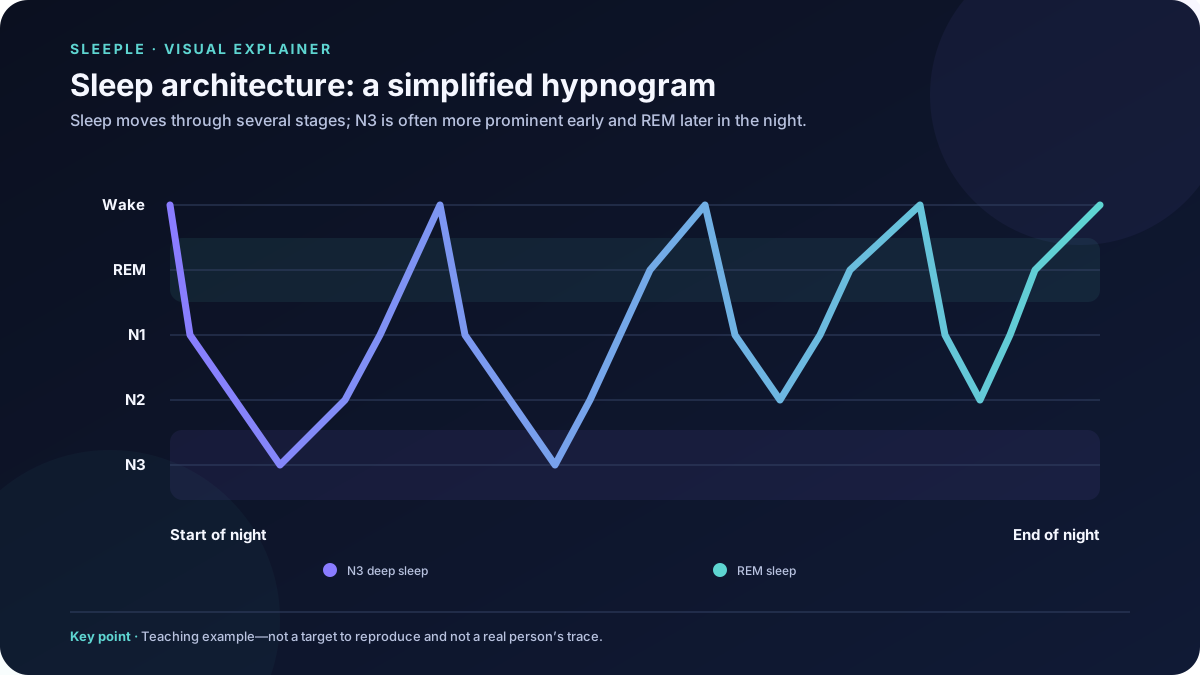
Sleep includes non-REM stages N1, N2 and N3, followed by rapid eye movement, or REM, sleep. The NHLBI explains that N3 is called deep or slow-wave sleep because of the pattern measured in brain activity. Polysomnography combines EEG, eye movements, muscle activity and other signals to score periods.
“Deep” describes slow waves and a relatively high arousal threshold. It does not mean that N1, N2 and REM are useless. N2 makes up a large portion of the night and contains distinct brain events; REM has different physiology. Healthy sleep is a complete architecture, not a competition won by N3.
Where does N3 occur?
N3 is concentrated in the first cycles, when homeostatic sleep pressure accumulated during wakefulness is high. As the night continues, that pressure declines and REM occupies more of later sleep. Cycles are not exactly ninety minutes for every person. The NHLBI describes typical cycles of about 80 to 100 minutes and several cycles per night.
This distribution helps explain why shortening the end of a night may preserve part of N3 while losing REM-rich sleep and total duration. It does not make five hours sufficient.
The stages at a glance
| Stage | Simplified description | Important limit |
|---|---|---|
| N1 | Transition from wake to sleep | Usually brief but variable |
| N2 | Non-REM sleep with spindles and K complexes | Large part of the night |
| N3 | Slow waves and a higher arousal threshold | More prominent early |
| REM | Distinct brain activity, rapid eye movements and muscle atonia | More prominent later |
The NCBI Bookshelf chapter on sleep stages provides a physiological overview. Like any summary, it does not replace formal scoring manuals or clinical interpretation.
02How much deep sleep do you need?
The scientifically honest answer is that there is no universal individual target. Reference studies describe distributions in samples, not prescriptions for everyone.
In a polysomnography study of 100 healthy adults aged 19 to 77, younger participants had a median N3 proportion around 20%, with broad variation. The median was lower among people over sixty and dispersion remained substantial. See Mitterling and colleagues. A separate reference dataset of 206 healthy adults also documents variation and associations with age and sex in that sample: reference data.
Those findings do not mean:
- 20% is every adult’s target;
- 15% proves disease;
- an older adult should regain a young adult’s value;
- a watch displaying 22% has reproduced polysomnography;
- more is always better.
Minutes or percentage?
Both can mislead. Someone sleeping five hours may display a relatively high N3 percentage while remaining short on total sleep. Someone sleeping eight hours may have more absolute N3 minutes but a lower percentage. The denominator changes the story.
A fictional example: sixty minutes in five hours equals 20%, whereas seventy-five minutes in eight hours is around 16%. The second sleeper has more N3 minutes and a longer night. Neither calculation can determine who is healthier without context.
03Why does deep sleep vary?
Age
An average decline in slow-wave sleep across adulthood is well established. The NHLBI says its amount peaks early in life and falls with age. Group averages do not predict every person: some older adults retain measurable N3, while others show little on one recorded night.
It would be misleading to sell a method promising to “restore your twenty-year-old level.” The clinical goal is sleep compatible with health and function, not artificial correction of an age-related average.
Sleep pressure
The longer someone remains awake, the more homeostatic pressure builds. After deprivation, slow-wave activity can rebound. Selective deprivation research observed recovery of slow-wave sleep on a subsequent night: Ferrara and colleagues.
This rebound is not a reason to deprive yourself to manufacture deep sleep. Sleep loss impairs alertness and removes other sleep. The body is compensating for disruption, not receiving a beneficial workout.
Activity, health and substances
Exercise, illness, fever, stress, alcohol, caffeine, medicines and sleep disorders can change architecture. Effects differ by dose, timing and population. An alcohol-affected night may show a different distribution without one stage score capturing all consequences.
Measurement variation
Even in a laboratory, two nights are not identical. A wearable adds algorithmic error to biological variability. A displayed drop from seventy to thirty-five minutes may combine real change with measurement uncertainty.
04What does deep sleep do?
N3 contributes to several processes, but it is misleading to call it the only restorative sleep. Overnight functions emerge from interactions between stages and body systems.
Memory and plasticity
Slow oscillations interact with spindles and other rhythms involved in some forms of memory consolidation. A human closed-loop auditory study increased slow oscillations and improved a declarative-memory task under its protocol: Ngo and colleagues.
That experiment does not prove that a playlist or consumer device improves memory in everyone. Phase detection, timing, population and outcome measurement are fundamental.
Metabolism
An experiment selectively suppressing slow-wave sleep in healthy young adults observed changes in insulin sensitivity and glucose tolerance: Tasali and colleagues. It supports the importance of architecture but does not show that raising N3 beyond its natural level prevents diabetes.
Cardiovascular and autonomic physiology
Heart rate, blood pressure and autonomic regulation change by stage. Observational and experimental work suggests that slow waves participate in this physiology. “Biologically important” still does not mean “more is always better.”
Recovery and hormones
Some secretion patterns, including growth hormone, are associated with slow-wave sleep. Online content turns this relationship into promises of muscle growth and anti-ageing. I cannot confirm that a product raising a consumer N3 score automatically improves sports recovery, immunity or body composition.
Total sleep, nutrition, training, recovery days and health operate together. Deep sleep should not receive credit for every benefit of sleep.
05Does a watch really measure deep sleep?
Polysomnography uses EEG. A consumer watch or ring estimates stages from movement, heart rate, heart-rate variability and sometimes temperature or oxygenation. Its algorithm classifies time windows probabilistically.
A 2025 validation comparing six wrist devices with polysomnography found strong general sleep detection but more limited wake and detailed multistage classification: Schyvens and colleagues. Performance of one device and software version cannot automatically be transferred to another.
False precision
A screen reports “1 h 17” as though every minute were directly counted. The number is produced by a model. Display precision can exceed classification accuracy.
Use a tracker to:
- observe bedtime and wake-time regularity;
- estimate a broad duration trend over weeks;
- identify a major change worth discussing;
- explore associations with habits cautiously.
Do not use it to:
- diagnose N3 deficiency;
- rule out sleep apnoea;
- alter prescribed medicine;
- compare your brain with a friend’s;
- decide that a short night was sufficient because the percentage looked good.
Can you increase deep sleep naturally?
A more accurate goal is to support normal architecture. The body strongly regulates N3. Robust measures remove barriers to sleep rather than forcing one stage.
Allow enough total sleep
Protect a window compatible with your need and functioning. A short night can preserve N3 proportionally while losing sleep overall. If a diary reveals restriction, restore opportunity gradually rather than searching for a supplement.
Stabilise timing cues
A reasonably consistent wake time, daylight and regular activity support timing. Minute-perfect regularity is unnecessary; large repeated swings matter more.
Exercise regularly
Regular physical activity benefits health and may alter some sleep parameters. The specific N3 response differs by exercise, population and protocol. Choose sustainable activity rather than extreme training intended to raise a score.
Manage caffeine and alcohol
Caffeine can delay or fragment sleep depending on dose, timing and sensitivity. A recent controlled trial examined dose and timing effects: Gardiner and colleagues. It does not create one universal cut-off. Run a personal trial by moving the final intake.
Alcohol is not a healthy N3 enhancer. Even when it changes stage distribution and initial drowsiness, it may fragment later sleep and worsen breathing.
Treat fragmentation
Snoring with pauses, restless legs, pain, reflux, hot flushes, noise and insomnia can destabilise sleep. The relevant lever is treatment of the cause. Our polysomnography guide explains when a study may be considered.
07Acoustic stimulation, temperature and supplements
Synchronous sounds
Research systems detect slow oscillations with EEG and deliver sounds at a precise phase. Trials report changes in some participants. A study in chronically short sleepers also found variable response: Diep and colleagues.
Playing generic pink noise without EEG phase detection is not the same intervention. I cannot confirm that an app reliably increases health, recovery or N3 minutes for everyone.
Temperature
An excessively warm room can disturb sleep, but there is no perfect temperature for every person. Bedding, clothing, season, age and health alter comfort. Adjust progressively and evaluate continuity, not N3 alone.
Magnesium, herbs and other products
Evidence differs by substance, deficiency, dose and population. A subjective improvement does not prove an increase in N3. “Natural” does not exclude adverse effects or interactions. Do not stack products to correct a score. Our evidence review of magnesium for sleep, forms and dose covers what clinical trials actually show.
08When should “low deep sleep” lead to medical advice?
People do not generally need care for one wearable value. Seek help for symptoms or sustained change:
- major daytime sleepiness;
- persistent fatigue despite adequate opportunity;
- loud snoring, observed pauses or choking;
- frequent awakenings, pain or restless legs;
- chronic insomnia;
- unusual night-time behaviour;
- a clear decline after medicine or illness.
The clinician assesses sleep as a whole. Polysomnography can measure N3, but is not ordered to validate a fitness target. It answers a clinical question.
09A tracker plan that avoids obsession
For two weeks, hide detailed stages if possible. Record only approximate duration, timing, awakenings, substances and function. Then compare this with the device trend without expecting daily agreement.
If function improves while displayed N3 falls, prioritise function. If the number improves while sleepiness worsens, do not let the app provide false reassurance. Data should remain subordinate to symptoms and safety.
10Common mistakes
| Mistake | Why it is a problem |
|---|---|
| Targeting ninety minutes for everyone | No universal individual quota |
| Comparing different brands | Sensors and algorithms differ |
| Depriving yourself to create rebound | Safety risk and loss of other stages |
| Taking a supplement for the score | Evidence often indirect or absent |
| Ignoring symptoms because the score is good | A tracker cannot diagnose |
| Treating REM as less useful | Stages are complementary |
Frequently asked questions
How much deep sleep do I need?
There is no universal quota. Healthy young adults often average around one-fifth N3 in some studies, with broad variation. Age and many individual factors alter the proportion.
Is thirty minutes on my watch dangerous?
Not necessarily. The device estimates stages without EEG and nights vary. Consider trends, total duration and symptoms. Seek care for impact, not the number alone.
Can you have too much deep sleep?
A high watch value may be an estimate, calculation effect or normal variation. Polysomnography is interpreted in context. Do not try to reduce N3 because of one score.
Why does N3 decrease with age?
The average change in architecture is documented, but mechanisms are multiple and people differ. A reduction does not mean that all recovery becomes impossible.
Does exercise increase N3?
Some research finds changes, but the effect varies. Exercise for health and overall sleep, not to guarantee a number of minutes.
Does pink noise work?
Precisely EEG-timed stimulation has experimental results. A standard audio track is not the same intervention, and general clinical benefits remain uncertain.
Is N3 more important than REM?
No. They have complementary physiology and functions. Maximising one stage at the expense of duration or continuity is not coherent.
How can I know whether I truly lack it?
A wearable is insufficient. Even polysomnography describes a night and is interpreted with age, symptoms and the clinical question. Speak to a clinician if function or breathing is concerning.
12How should you interpret three common tracker scenarios?
The score falls but you feel well
An algorithm update, a looser strap, a different night or genuine variation can explain the change. First ask whether duration, awakenings and daytime function also changed. If nothing else is worse, do not immediately turn the number into a medical problem.
Keep the same device and wear conditions when looking for a trend. Comparing a new ring with an old watch mixes two models. Consistency does not make the estimate clinically exact, but it removes some avoidable noise.
Check the scale as well. Some apps report absolute minutes, some a percentage and others a composite “restoration” score. Those are not interchangeable. A product may change the formula without making the historical series comparable.
The score is high but you are sleepy
A score must never cancel a symptom. Insufficient duration, sleep apnoea, a medicine or a hypersomnolence disorder remains possible even when an app praises the night. Drowsiness at the wheel means not driving and arranging assessment.
An app may correctly identify immobility while misclassifying quiet wakefulness or detailed stages. Its positive result does not replace a partner’s observation of breathing pauses or a prescribed investigation.
The number varies and you become anxious
When every value triggers another intervention, measurement can perpetuate hypervigilance. Clinical literature has used the term orthosomnia for the pursuit of perfect sleep through tracker data. It is not a label to apply to yourself, but the mechanism is useful.
Hide stages for several weeks. Retain only approximate timing and daytime function, then reassess whether the data help. If fear persists, discuss it during an insomnia assessment or CBT-I. Tracking should support a decision, not create a permanent nightly examination.
13Deep sleep in specific situations
After an all-nighter
Sleep pressure rises and slow-wave activity may be favoured during recovery. That does not guarantee complete recovery in one night or instantly restore every performance. Never schedule deprivation as a method of increasing N3.
In athletes
Training load, late competition, pain and travel can alter sleep. A low score does not prove overtraining, and a high score does not prove complete recovery. Performance, pain, mood, injury frequency, nutrition and training load belong in the assessment.
If an athlete continually chases N3 by extending time in bed without sleepiness, sleep may become a source of pressure. A stable opportunity, daytime recovery and management of pain are more actionable than one stage target.
During illness
Fever, inflammation, medicine, cough and discomfort can change both sleep and the signals used by a wearable. An unusual value during a few sick nights should not be compared with a healthy period as if conditions were identical.
Seek care for the illness according to symptoms. Raising N3 is not the treatment for fever, respiratory difficulty or pain.
After alcohol
Alcohol can change stage distribution and fragment later sleep. A device may still display an apparently acceptable score. Heart rate, movement and an algorithm do not summarise every physiological effect. Do not use alcohol to increase deep sleep.
During ageing
Lower average N3 is not evidence that an older adult must buy a product or that healthy sleep is impossible. Function, continuity, breathing, pain and medication are more actionable. A sudden change deserves assessment, while a gradual age-associated difference in a stage estimate should be interpreted cautiously.
14Should you request polysomnography to measure N3?
Not solely to validate a watch percentage. Polysomnography uses multiple signals and clinical interpretation. It is ordered when a clinician investigates problems such as sleep-disordered breathing, certain movements, unusual behaviour or another sleep condition.
If a study is performed, N3 is interpreted with total sleep time, sleep efficiency, arousals, respiration, movement, age, medicine and a possible first-night laboratory effect. The report is not a school mark decided by one “deep sleep” row.
Prepare the question that might justify the study: “Do my loud snoring, witnessed pauses and daytime sleepiness suggest apnoea?” That leads to a more relevant clinical decision than “My watch says forty-two minutes; can you confirm it?”
15A healthier hierarchy of sleep goals
Prioritise:
- safety and freedom from uncontrollable sleepiness;
- enough opportunity for sleep;
- acceptable regularity and continuity;
- investigation of symptoms and treatment of a cause;
- only then, optional observation of stages.
This hierarchy puts the metric in its proper place. Deep sleep is an important part of architecture, but a person cannot directly steer it like a training-zone target.
What should a useful experiment look like?
Choose one safe change, such as moving late caffeine earlier or restoring adequate sleep opportunity. Keep it stable for one to two weeks. Define success through daytime alertness, continuity and a sustainable routine before looking at N3.
Do not select only the nights that support the hypothesis. If the score changes but function does not, describe the result as uncertain. A personal experiment can guide habits but cannot prove a medical mechanism.
Should you wake during the night to improve or measure deep sleep?
No. Setting alarms to inspect a stage, restart an audio track or enter data fragments the sleep you are trying to protect. Consumer devices are designed to estimate after the fact; they cannot turn repeated awakenings into a valid laboratory protocol.
If a research or clinical device asks for an action, follow its approved instructions. Otherwise, keep the night free from monitoring decisions. Review data later and less frequently, when you are fully awake.
What if two apps disagree?
They may use different sensors, epoch lengths, definitions and algorithms. Neither should be declared correct solely because its number looks more plausible. Compare each device only with its own historical trend, and avoid averaging two incompatible estimates.
A validated comparison against polysomnography provides stronger evidence than user reviews, but validation in one sample and software version still has limits. Updates can change performance. For clinical symptoms, skip the contest between apps and seek appropriate assessment.
Does remembering dreams reveal low deep sleep?
No. Dream recall depends on awakenings, REM and non-REM experiences, attention and memory. Remembering many dreams does not prove that N3 was absent, and remembering none does not prove abundant deep sleep. A dream diary answers a different question from an EEG.
16What a better weekly review looks like
Review the same device over a week rather than reacting to one morning. Start with total sleep opportunity, wake-time regularity, disruptive awakenings and daytime alertness. Place the estimated N3 value underneath those indicators, not above them. If the deep-sleep estimate falls while your schedule, symptoms and function remain stable, describe the change as uncertain. If the estimate looks high but you remain markedly sleepy, snore loudly or have witnessed breathing pauses, the reassuring score should not delay assessment.
Keep the device and software version consistent when comparing trends, and note illness, alcohol, travel or a medicine change that could alter sleep or measurement. The 2025 validation study of commercial wrist devices supports treating stage estimates as imperfect classifications rather than laboratory-equivalent measurements. A weekly review should therefore guide questions and habits, not declare that recovery succeeded or failed.
17Conclusion
Deep sleep matters, but it is not a recovery gauge to fill. N3 varies, declines on average with age and is clinically identified through brain activity. Watches offer estimates that may help with trends, not minute-level diagnosis.
The better target is a sufficiently long, regular and unfragmented night. Treat symptoms, not the score. Supplements, sounds and alarms promising a guaranteed “boost” often reduce complex physiology to a simple product; the evidence does not justify that certainty.
18Main sources
Evidence last checked: 17 August 2026.
- NHLBI — Sleep phases and stages
- NCBI Bookshelf — Physiology, Sleep Stages
- Mitterling T et al. — Polysomnography in 100 healthy sleepers
- Danker-Hopfe H et al. — Reference data for sleep in healthy adults
- Tasali E et al. — Slow-wave sleep and glucose regulation
- Ngo HVV et al. — Closed-loop auditory stimulation and memory
- Schyvens AM et al. — Validation of wrist-worn sleep trackers
- Gardiner CL et al. — Dose and timing effects of caffeine
- Diep C et al. — Acoustic enhancement in short sleepers
General information: an N3 score cannot diagnose a disorder. Do not alter treatment or deprive yourself of sleep to change stage distribution.